
How to Search Criminal Dockets
Start with the official Gilpin County Docket Search. Pick the right court level before anything else. County Court covers misdemeanors, traffic cases, infractions, protection orders, and early felony filings. District Court handles a felony CR case. Choosing both levels helps when a felony began in County Court and you do not yet know the District file. Once the court is set, narrow the criminal docket. Add a date range plus at least one filter that is not a date.
- Choose Gilpin County and, when useful, Gilpin Combined Court.
- Select County, District, or Both based on the offense level and case stage.
- Enter party, attorney, division, or case-number parts: year, class, and sequence.
- Match the case number, hearing type, location, appearance mode, and courtroom.
- Contact the clerk for the ROA, charge document, disposition, sentence order, or a changed setting.
Beyond the docket search itself, the clerk offers several ways in. Call 303-582-5522 or email GilpinClerksOffice@judicial.state.co.us. Visit the counter, or mail the office at 2960 Dory Hill Road, Suite 200, Black Hawk. The official Record/Document Request Form works too. CCE handles authorized filings and a party's own case. It is not a public criminal name search.
Gilpin CR, M, T, JD Classes
A Gilpin County case number splits into a four-digit year, a class letter, and a sequence of one to six digits. CR marks a District criminal case. M marks a County misdemeanor, T a state traffic case, and JD juvenile delinquency. The form also lists R, but the official local material does not explain it, so treat it cautiously rather than guessing. For a safe illustration, look at 2026CR30001. It shows the field layout only and matches no real case. Missing the class? Choose Both court levels and filter by a name or attorney. Municipal citations may never appear here. Central City and Black Hawk hold their own ordinance and city-ticket files. That holds unless a charge belongs in Gilpin County Court. Party and business searches run in separate modes. Attorney searches accept a name or bar number. County, courthouse, and court type are distinct filters. Picking Gilpin County does not settle whether your docket query covers County Court, District Court, or both. When a matter has moved from preliminary felony work into a District CR file, run both levels. Compare the full number. That beats assuming the first calendar hit is the whole criminal record.
Gilpin Criminal Docket Venue Split
One clerk serves both state trial-court levels. Yet the case class still drives any docket search. County Court takes misdemeanors, traffic, protection orders, and most early felony work. The later CR felony case belongs to District Court. Central City and Black Hawk keep municipal ordinance files with their own clerks. Black Hawk sends DUI, DWAI, registration complaints, and domestic-violence matters straight to Gilpin County Court. The issuing court on a notice is a better first clue. The city where the event happened matters less. A city clerk cannot certify a state file. The Gilpin clerk cannot certify a municipal one.
What a Criminal Docket Shows
The public criminal calendar shows a scheduled event and nothing more. It is not a complete criminal ROA. Treat every field as a calendar field for a current setting, never as proof of an outcome.
| Date, time, duration | The published timing and allotted length of the event. |
|---|---|
| Name label | The displayed caption used to help match the matter. |
| Case number | The year, criminal class, and sequence. |
| Hearing type | A label such as arraignment, appearance on bond, review, motions, or trial. |
| Location and appearance | The courthouse, courtroom, and virtual, in-person, or no-appearance direction. |
Plenty is missing. Charges, statute level, lawyers, arrest data, bond amount, plea, disposition, sentence, fines, restitution, ROA history, and document images are all absent. When those facts matter, request an ROA, a Complaint/Information, a Disposition/Sentence Order, a Protection Order, or the Ticket itself.
Gilpin Criminal Calendar Omits Outcomes
A hearing label proves one thing only: an event was published. It does not show that a plea was entered. It does not show a charge staying the same, a motion granted, or a sentence imposed. And the missing document links are no paywall. The public interface simply does not deliver those files. Read the hearing type as an event label, nothing more. Check it against the latest notice and appearance mode. Then request the ROA for the chronology and the actual order for exact terms. Plain copies run $0.25 per page under the state request form. Certification or exemplification adds $20 per document. A name search is $5, and an off-site file can carry its actual retrieval cost.
If the result is missing: widen the date range, check court level and class, test the full name or number parts, then call the Gilpin clerk. Absence does not prove sealing or dismissal.
Stages on a Criminal Docket
A Gilpin County criminal matter often opens with a complaint or citation. County Court handles misdemeanors and most preliminary felony processing. The felony prosecution then continues in District Court. It runs under a CR case. Expect settings such as first appearance, arraignment, bond review, pretrial, motions, plea, or trial. The ROA and the filed orders carry the outcome.
Docket flow: Filing › Arraignment › Pretrial › Plea or Trial › Disposition › Sentencing.
A transfer can create a new class. It can also create a new case record. The initial County Court felony complaint is not always the final District Court CR file. When tracking that transition in the court docket, search both levels. Appeals or post-conviction work may add later entries or open a separate appellate docket.
Gilpin Criminal Docket Reset Checks
A Gilpin County public calendar will not show every reset in a setting's history. So what do you do when an old printout and a new notice disagree? Start with the case number and the appearance mode. Then run a fresh Docket Search. Call the Combined Court clerk for the authoritative answer.
A live court notice or the ROA gives the answer. It tells you whether an event was vacated, continued, or actually held. One thing the calendar will never prove is dismissal. A date that vanished from the list does not mean the charge went away. Virtual access needs advance approval, and watching a stream is not an appearance. These reset checks matter most for arraignment, bond, motions, and trial settings, where a missed event can carry immediate consequences for the case.
From Gilpin Complaint to CR Case
Gilpin County's combined clerk structure can hide an important jurisdiction change. A single office holds both files. County Court and District Court do different work with them. County Court receives the felony complaint. It handles the preliminary steps, while District Court carries the general-jurisdiction felony prosecution. Search only the first case number and you may miss the later CR calendar entirely.
| Criminal venue | Work | Search route |
|---|---|---|
| Gilpin County Court | Misdemeanors, traffic, protection orders, initial felony work | County or Both, then combined clerk |
| Gilpin District Court | CR felony prosecution | District or Both, then combined clerk |
| Central City Municipal Court | City charter and ordinance violations | City contact and records route |
| Black Hawk Municipal Court | Municipal misdemeanor, traffic, and parking | Municipal clerk; excluded charges go to County Court |
Black Hawk sends certain complaints straight to Gilpin County Court. DUI, DWAI, vehicle-registration complaints, and domestic-violence cases all go there expressly. That makes the issuing court printed on a notice your first routing clue in any docket search.
Which Court Holds Criminal Dockets
Where does a Gilpin County criminal docket actually live? The Colorado trial-court jurisdiction guide puts misdemeanors and initial felony proceedings in County Court. General felony jurisdiction sits in District Court. Both Gilpin courts sit at the Combined Court and share one clerk office. City courts keep their own records separately.
Appeals run upward from there. County Court judgments ordinarily go to District Court, while District Court judgments generally reach the Colorado Court of Appeals. The Colorado Supreme Court stands as the court of last resort. Remember that an appellate docket is separate from the trial-court setting list. A concluded trial matter may take a different court search.
Gilpin Weekend Bond Calendar
Weekend initial bond hearings run on a separate First Judicial District schedule shared with Jefferson County. Gilpin County does not set those dates alone. The official weekend bond page shows the current schedule, and holiday weeks can change it, so consult that page before relying on any date.
Check the live schedule with the clerk. Do not copy a date into a lasting calendar. A regular appearance-on-bond setting and a weekend initial bond hearing are not the same event. Virtual links require approval too. Watching a livestream does not count as appearing. When anything conflicts, the latest court notice, the current calendar entry, and clerk direction control.
Gilpin Criminal Docket Request Choices
The official record form splits the ROA from the documents behind it. A criminal requester can name the Complaint or Information. Other choices include a Disposition or Sentence Order, a Protection Order, or a Ticket. The ROA gives you the chronology of the court docket. The selected filing gives you the exact words entered in the file.
Copy fees are modest. Plain copies cost $0.25 per page under the displayed schedule. Certification or exemplification adds $20 per document. A name search runs $5, and an older file can carry its actual retrieval cost. A hearing transcript goes through JDF 4 and the local transcript channel, not this document menu.
Public Access and Sealed Criminal Dockets
Colorado CJD 05-01 governs access to court records. It balances public access against privacy, accuracy, and cost. CJD 06-01 supports the fees shown by the state request process. Judicial Branch administrative records follow P.A.I.R.R. 2 instead. That route does not get you a specific criminal file.
Access boundary: suppressed, sealed, juvenile, probate, and protected material may be withheld or require government photo identification. A public event does not open confidential content.
The public calendar leaves a lot out. Addresses, birth dates, financial identifiers, charges, documents, and balances are all omitted. A person entitled to restricted material may need proof of identity. They may also need party or counsel status, or a court order. Ask for the exact ROA or a named record rather than making a broad request.
The state form asks for contact and mailing details. It also requests case number, case type, year, county, party names, and other identifying facts. Criminal document choices include Complaint or Information, Disposition or Sentence Order, Protection Order, and Ticket. Register of Action can be selected separately. Give enough detail to distinguish the file. Do not treat a broad name search as a substitute for the known case number and court level.
Gilpin Competency Court Docket
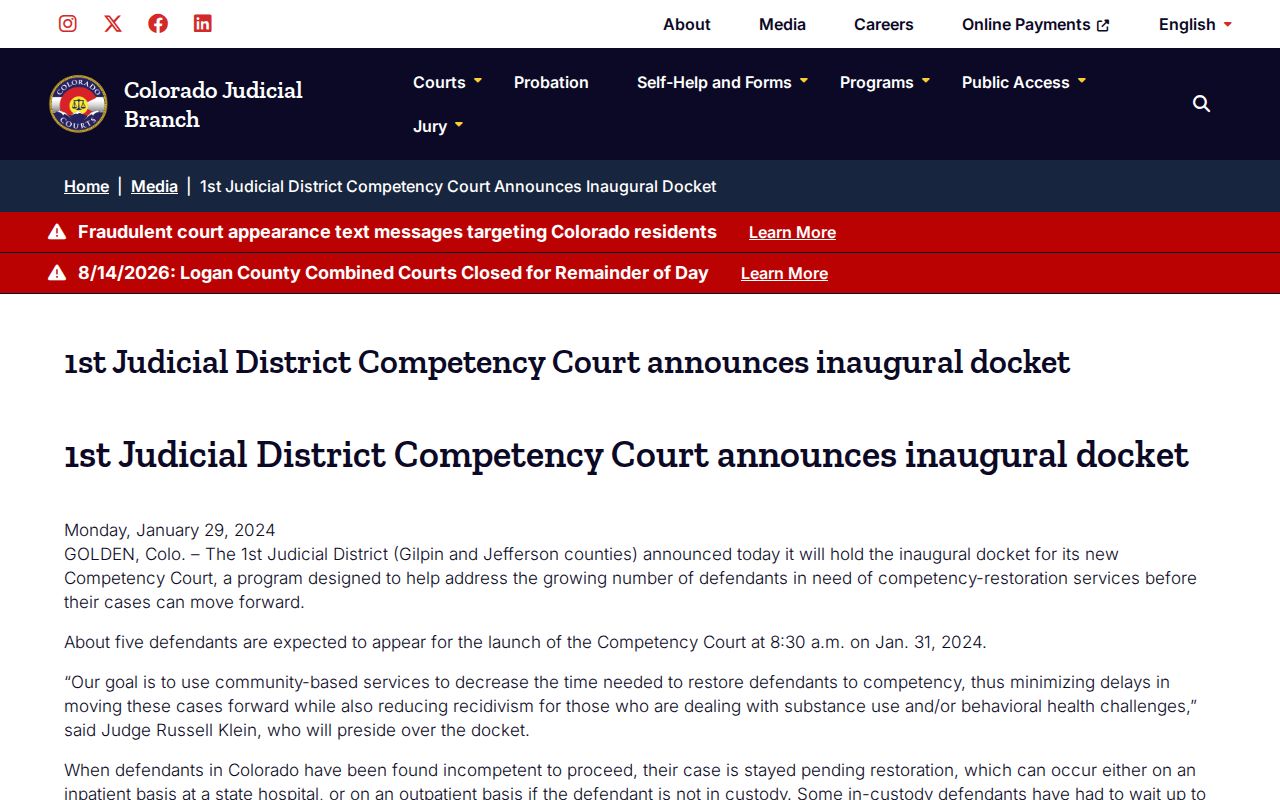
Competency Court opened on January 31, 2024 under the First Judicial District. It serves defendants found incompetent to proceed. Their underlying cases sit stayed for restoration. The docket belongs to a family of specialty programs in the district, alongside Adult Recovery, Adult Mental Health, Veterans Treatment, and FIT. The official statewide evaluation lists the veterans program as serving Jefferson and Gilpin counties.
For the launch itself, turn to the courts. The official Competency Court announcement spells out that first docket. It also explains how the district introduced it.
No separate public specialty case class exists for Competency Court. Program events generally stay tied to an underlying file. Do not expect the calendar to reveal treatment details. The January 2025 First District overview supplies local staffing and scale context. Read it against the January 2024 overview for comparison.
The filing numbers give a sense of the docket load. FY2024 shows 314 County misdemeanor filings and 135 County felony complaints. It also shows 283 traffic filings and 372 infractions. District Court recorded 153 criminal filings and 176 terminations. The county-judge appointment notice documents Timothy J. Lane's 2023 appointment. These figures describe court structure, never the outcome of any case.